
Late last year, at our annual Curious Public Retreat at Friday Harbour in Innisfil, we presented some research to each other on the communications market in Canada.
We saw a few trends that surprised us.
Total Market Size:
First of all, the Canadian communications landscape is bigger than you might think. If our figures are accurate, the total yearly value of the market is about $3.9 billion – that’s slightly larger than the size of the Canadian Craft Beer industry, and slightly less than the Canadian Video Game Industry.
Market Segments:
The communications industry – as we defined it – fits into four main buckets: Content Creation (writing), Strategic Communications, Public Relations (PR) and Government Relations (GR).
This last bucket may feel a little controversial, but it’s been our experience that GR and Comms strategy often fit together so seamlessly, it’s difficult to separate them.
Segment Values:
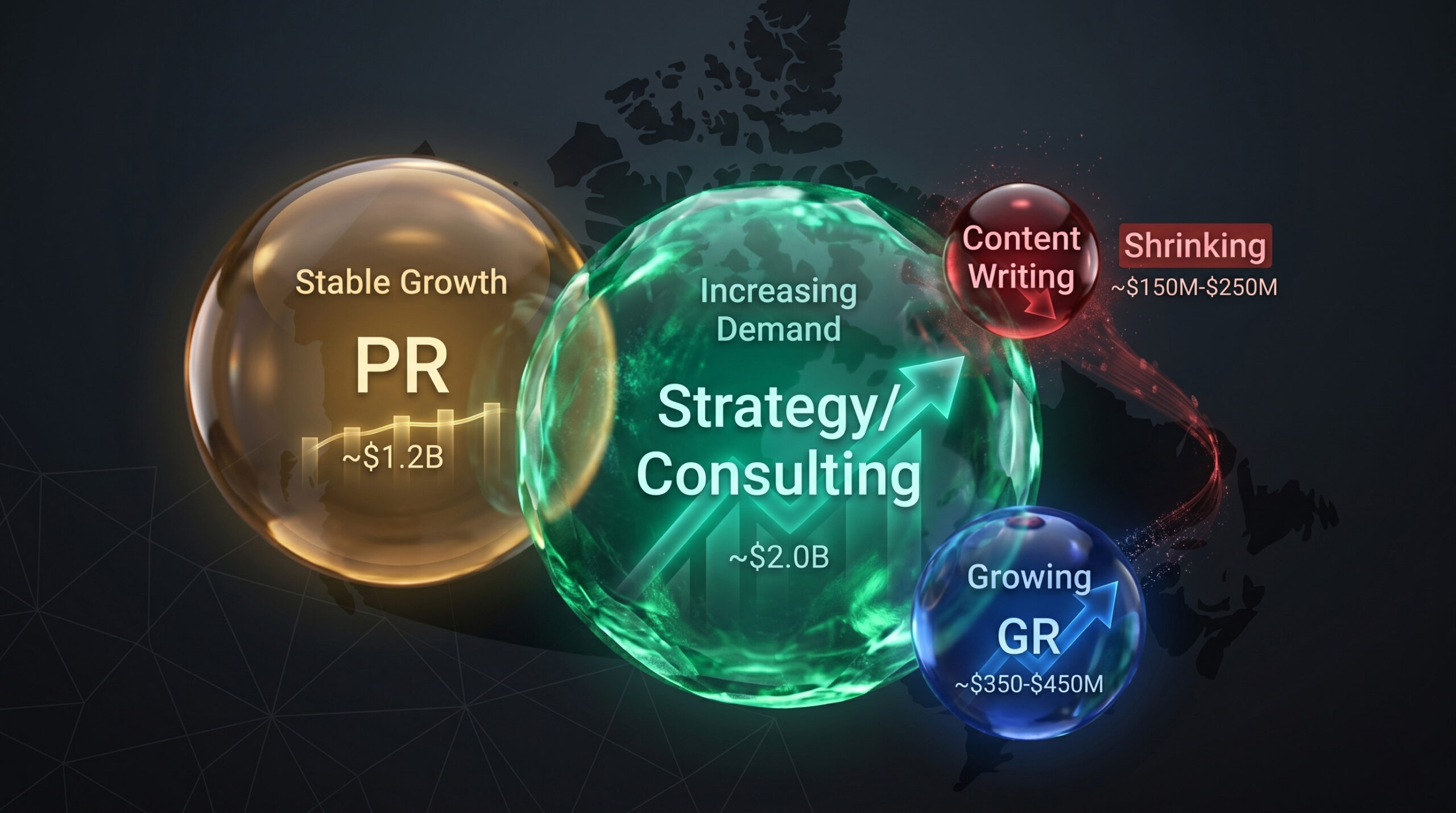
By the numbers, PR remains – surprisingly, given the changes in the media landscape – a steady, established market at roughly $1.2 billion, practiced by more than 2,400 firms across Canada. Strategic Communications sits at about $2 billion and has between 1,200 and 1,600 firms in the mix. GR in Canada is a smaller, harder-to-measure market — in the range of $350 to $450 million — but it also has only a few hundred firms operating nationally. Content writing is shrinking at roughly $150 to $250 million, with about 1,000 firms of various sizes competing for that work.
Market Distribution:
In other words, some segments (Content Writing) are packed with firms chasing a smaller pool of work. Others (GR) are more specialized and in high demand. Strategy and consulting continues to grow as organizations look for clearer direction and better judgment at the senior level. PR holds its ground, though there are fewer and fewer avenues to pitch traditional media so PR has expanded in scope to include pitches to podcasters and influencers.
Who is Growing, Who is Shrinking:
There’s no doubt AI is disrupting the industry.
Content writing is the most susceptible overall. It is crowded, price-sensitive, and the entry-level work of content writing is under threat as AI tools make basic production faster and cheaper. It’s what Colin Horgan calls “autotune for writers.” That puts pressure on firms that rely on volume work.
AI raises the floor…However, the ceiling remains limitless, and that’s where humans excel.
For a lot of smaller companies and organizations, AI raises the floor — it brings their content into a place of competence and clarity. However, the ceiling remains limitless, and that’s where humans excel. So top-tier, creative, human writing will always have a place – but with a caveat: looking at the numbers, we expect the number of firms to decrease and a few, high-end shops to remain.
Work that has a high degree of human interaction – PR and GR – are safest. However, even in GR, some consultants expect AI disruption – especially when it comes to productivity – to reduce the employee footprint in larger firms, especially among junior staffers. In the future, we may see more firms that are stacked with senior talent – but with a very restricted pipeline for humans to enter at a junior level. This will cause challenges over the long term. And Theil-backed Objection AI – which has its detractors – is also threatening to disrupt PR.
Conclusion:
Overall, the Curious Public team’s analysis is that the directional shift in our industry – perhaps not too surprisingly – leans towards higher-value advisory work. Strategic communications consulting, for example, tends to lead to deeper work and longer relationships. Our best advice to our colleagues in Comms is that the firms that shift in that direction are more likely to hold their ground as the market continues to change.