
Every week, a new headline tells you SEO is a thing of the past, AI has changed everything, and you need to hire a specialist if you want to show up in search. No wonder search and answer engine optimization feel like a black box: complex, gatekept, and out of reach unless you pay the right person to manage it.
But it’s not. It’s a long game with some clear rules, and I’m going to show you what playing that game consistently looks like using our own Curious Public data and experience.
A note on generative AI search before I dive in:
Yes, people are increasingly getting answers from ChatGPT, Claude, and Google’s own AI overviews rather than clicking through to websites. And yes, that’s changing the game. But here’s what hasn’t changed: those tools are pulling from somewhere. The sources that show up in AI-generated answers are the ones that have built credibility over time through consistent publishing, clear expertise signals, and a web presence that’s structured to be understood. The fundamentals of content marketing didn’t die when AI search arrived. If anything, the bar for being a credible, findable source just got higher.
Google Search Console and Analytics are the only places we can pull longitudinal data right now. AI search doesn’t hand us an analytics dashboard. So that’s what we’re working with. And we think the data proves that what we tell clients is true.
The Data Snapshot and What It Means
At the beginning of this year, I was creating our monthly marketing dashboard to share with the team. I pulled our Google Search Console data and compared the last three months against the same window the year prior. Here’s what I saw:
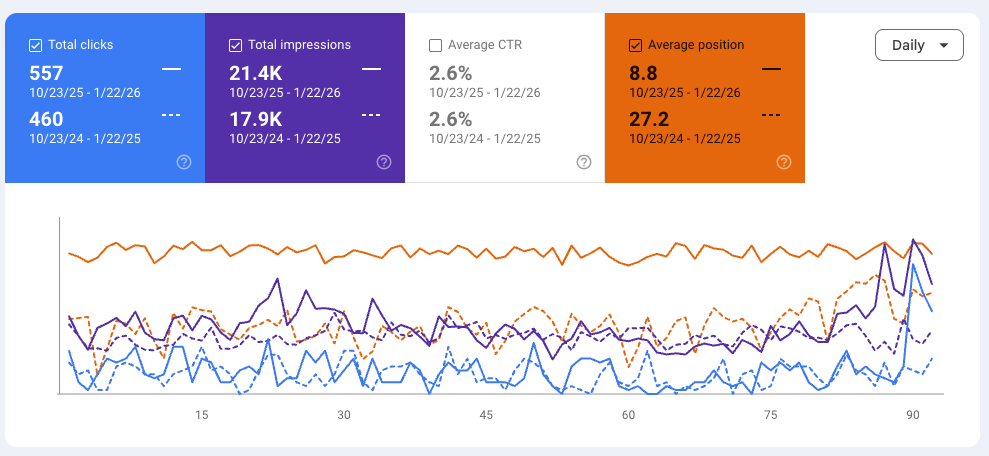
Clicks up 21% year over year: Total clicks climbed from 460 to 557 over the same three-month window compared to a year prior. Not a dramatic number in isolation, but directionally meaningful.
Impressions up nearly 20%: We went from appearing in 17.9K searches to 21.4K. That means we’re showing up in a lot more conversations than we were a year ago.
Average page position moved to 9 (page one): A year ago we were sitting on page three–meaning we were essentially invisible. This shift is the one we’d point to first if someone asked what actually changed.
CTR held flat at 2.6%–and that’s a good thing: Click-through rate staying steady while impressions jump significantly is a signal worth pausing on. When impressions increase, CTR typically drops because you’re reaching a wider audience and average relevance decreases. We also know that clicks across the web are declining as AI-generated answers reduce the need to visit a site at all. So holding steady means the visibility we’re gaining is still relevant.
Branded search notably up: More people are searching for us by name (Curious Public) or by team member name than a year ago. That means awareness is growing; people are encountering us somewhere and deciding to go look us up directly. You can buy clicks. You can’t really buy the kind of familiarity that makes someone type your name into a search bar on purpose. When it climbs, something is working–even if the attribution isn’t clean.
What We Actually Did to Get Here
It’s all about content.
We committed to a content marketing/thought leadership strategy: we aimed to show up consistently and credibly, across a few different channels. This strategy didn’t come with a budget, but it did require buy-in from team members and “people resources.”
Content that builds expertise and authority
Our blogs are written by the team member who holds the expertise and experience. Some are the kind you settle into with your morning coffee (like, Take My Advice: Pull down your pants and slide on the ice by Lloyd Rang), others are practical and takeaway-forward (like, Ensuring Your Story Resonates with Canadian Journalists by Anne Marie Aikins). The byline matters to readers and to search engines.
Content that builds relationships and reach
We also run quarterly webinars that bring external industry voices into the conversation on topics our audience cares about. A quarterly newsletter keeps us in the inboxes of people who already know who we are. And social media is here to help the content we’re creating travel beyond our website to the audiences we want to reach.
The human layer
This one is a key piece. Our team is out in the world–workshops, media mentions, speaking engagements, networking events. Search and reputation aren’t separate things. When people encounter your team in a room, they often go looking for you online afterward. That shows up in the data, even if you can’t draw a straight line to it.
The backend work that makes everything findable
This is your clean site structure, descriptive page titles, meta descriptions, keyword phrases, alt text on images, etc. Now, our site isn’t perfect; it’s a work in progress. But over the last year and half we’ve been more intentional about it and that’s making a difference. For example, beyond branded search we are now seeing an increase in hits to our media training page and related leads contacting us.
It’s a Slow Burn Strategy
Remember: you don’t need a complex content operation. You need to be confident in your expertise, create a clear lane, real expertise, and enough patience to let it build.
This didn’t happen in 90 days. Attribution can be a challenge. We can’t always draw a straight line from content to new business, but it does open doors and help land leads. Branded search is a simple metric worth watching. If it’s flat or declining after a year, something isn’t landing. If it’s climbing, your work is making an impact.
We’re working alongside organizations in the education and mental health space who are just starting to build a content strategy. The starting point is always the same: Pick a lane. Stay in it. Give it time.
Does your organization need a content and thought leadership strategy? Send us a message, we’re here to help.